• Home
Tumble CardsTumble Cards

Click and Flip

Tumble Cards

Print sheetthe whole stack on A4, front and back
Index Download Compass Back

My stack

TUM-011
Knowledge K · Mead · Moss · Red ± 2 min read
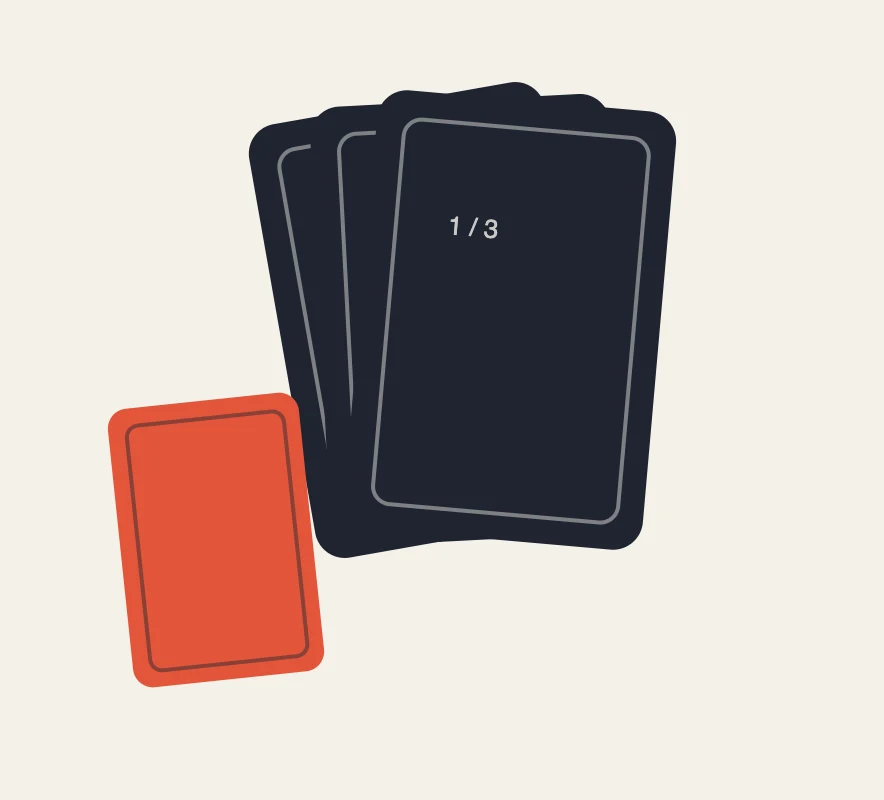
Three larger cards fanned out behind one small trading card STACK
Two cards on what a stack is: why I exist, and what order means. — Tumble Cards
K · Mead · Moss · Red dna:ggcaacaagggtgattaggacttagtcgggggttatgtaaaaacggacagcgaggaatttgaac TUM-011
Edition 1Tumble CardsTurn ↻
Index Download Compass Back
Download
Edition 1Tumble CardsTurn ↻

How does this work?

No website and no menu: everything here is a card — one thing, readable at a glance, independent enough to stand on its own.

Cards belong to a world and grow in families; stacks give them order. What you are looking at is one of them.

Reading the card
NumberTop right, permanent. A number is never reused and never moves to another card.
TurnClick or swipe. The front shows, the back explains — a card has no other sides.
MenuThe three lines, top left: back, turn, the index of this world, and the printable worksheet.
DNAThe sequence in the footer. It identifies a card, even away from this screen.
Every card stands on its own. Take one to the workbench and the rest can stay where they are.
Index Download Compass Back

My stack

TUM-012
Knowledge K · Gold · Gold · Gold

1.Why I exist

A trading card is small on purpose. She says one thing, well, and then she stops. That is her strength — and her limit. Some stories do not fit in four lines and a picture.

So the small card gets a stack. Not a page that scrolls on forever, but bigger cards, one after the other, with a cover in front. You read them the way you would read a short booklet: card by card, each one complete in itself.

The small card does not change. She stays what you met first; she just carries me behind her. That is why the stack bears her name: I am not a different thing, I am her story told at length.

Edition 1Tumble CardsTurn ↻
Index Download Compass Back
Download
Edition 1Tumble CardsTurn ↻

How does this work?

No website and no menu: everything here is a card — one thing, readable at a glance, independent enough to stand on its own.

Cards belong to a world and grow in families; stacks give them order. What you are looking at is one of them.

Reading the card
NumberTop right, permanent. A number is never reused and never moves to another card.
TurnClick or swipe. The front shows, the back explains — a card has no other sides.
MenuThe three lines, top left: back, turn, the index of this world, and the printable worksheet.
DNAThe sequence in the footer. It identifies a card, even away from this screen.
Every card stands on its own. Take one to the workbench and the rest can stay where they are.
Index Download Compass Back

My stack

TUM-013
Knowledge K · Brook · Stone · Clay

2.What order means

Most groups of cards have no order. A world is a context: her cards sit side by side and none comes first. A family groups cards that are about the same thing. A deck is a selection, laid out for a front door.

A stack is the one composition that carries order. Card 1 comes before card 2, because the story needs it to. The order lives on the stack, not on the cards: each member keeps her own number, and could be dealt elsewhere tomorrow.

So when you see '2 of 3' at the top of a card, that is where she sits in this stack. Her number — the one in the corner — is who she is.

Edition 1Tumble CardsTurn ↻
Index Download Compass Back
Download
Edition 1Tumble CardsTurn ↻

How does this work?

No website and no menu: everything here is a card — one thing, readable at a glance, independent enough to stand on its own.

Cards belong to a world and grow in families; stacks give them order. What you are looking at is one of them.

Reading the card
NumberTop right, permanent. A number is never reused and never moves to another card.
TurnClick or swipe. The front shows, the back explains — a card has no other sides.
MenuThe three lines, top left: back, turn, the index of this world, and the printable worksheet.
DNAThe sequence in the footer. It identifies a card, even away from this screen.
Every card stands on its own. Take one to the workbench and the rest can stay where they are.
Tumblecard
© 2026 · A Vic Boomer production